In short
- A 2025 joint advisory from 4 US groups (lifestyle medicine, nutrition, obesity medicine and The Obesity Society) is the main reference for eating on a GLP-1.
- Protein targets of 1.2 to 1.6 g per kg of body weight a day have been proposed during active weight loss; the advisory also offers a simpler 80 to 120 g a day.
- A 2025 expert consensus suggests at least 25 g of fiber a day for women and 30 g for men, and more than 2 liters of fluid a day.
- In the Zepbound weight trials, everyone got advice on a diet about 500 calories a day below their needs and at least 150 minutes of activity a week.
- To ease nausea, the advisory suggests smaller, more frequent meals and avoiding fatty or high-fiber foods in the first few days of treatment.
There is no official GLP-1 diet, but four US nutrition and obesity societies agree on what to eat: protein at every meal, smaller and more regular meals, plenty of fruits, vegetables, whole grains, beans, dairy and fish, enough fluids, and less refined starch, sugary drinks, fast food, red and processed meat, and alcohol. That is the core of a 2025 joint advisory from the American College of Lifestyle Medicine, the American Society for Nutrition, the Obesity Medicine Association and The Obesity Society (Mozaffarian et al.).
A GLP-1 cuts how much you want to eat. The advisory reports intake falling 16% to 39% compared with placebo. The challenge shifts from eating less to eating enough of the right things.
What the drug labels say about diet
The labels are short on food advice. Zepbound, Wegovy and the other weight-loss GLP-1s are approved for use alongside a reduced-calorie diet and more physical activity. In the Zepbound weight trials, everyone was counseled on a diet about 500 calories a day below their needs and at least 150 minutes of activity a week (Zepbound label, rev. 08/2026).
The injections can be taken with or without meals. The Wegovy pill is the exception: take it in the morning on an empty stomach with up to 4 ounces of plain water, and wait at least 30 minutes before eating, drinking or taking other pills (Wegovy label, rev. 06/2026).
The Zepbound Medication Guide also says to drink fluids, because diarrhea, nausea and vomiting can cause dehydration, which can lead to kidney problems.
What to eat on a GLP-1
The joint advisory sorts foods and habits into two columns.
| Eat more often | Limit |
|---|---|
| Fruits (berries, apples, citrus, bananas) | Refined carbohydrates (white flour, starches, added sugars) |
| Vegetables (broccoli, leafy greens, tomatoes, carrots, squash) | Sugar-sweetened drinks |
| Whole grains (oats, quinoa, brown rice, whole-grain bread and pasta) | Red and processed meats |
| Dairy (yogurt, milk, cheese) | Most fast food |
| Lean proteins (poultry, fish, seafood) and eggs | Sweets and savory snacks |
| Nuts and seeds, olive, canola and avocado oils | Large meals |
| Ginger or peppermint tea | Long stretches without eating |
| Regular, small meals at consistent times, enough fluids, minimal alcohol | Emotional, mindless or late-night eating |
Source: joint advisory, Table 6 (full text).
The advisory also leaves room for “portion-controlled treats” and flexibility with food choices. The goal is nutrient-dense food in a smaller total amount, not a list of forbidden items.
Protein: how much and where to get it
Protein matters more on a GLP-1 because weight loss takes some muscle with it, and a small appetite makes protein easy to under-eat. The advisory gives these numbers:
- The standard adult allowance is 0.8 g per kg of body weight a day.
- Targets of 1.2 to 1.6 g per kg a day have been proposed during active weight loss.
- Basing the target on actual weight can overestimate needs at higher body weights, so a simpler fixed target of 80 to 120 g a day may be easier to follow.
- Intake should not fall below 0.4 to 0.5 g per kg a day, and long-term intake above 2 g per kg a day should be avoided.
A 2025 expert consensus statement, whose project management and writing support Nestlé Health Science funded, suggests 1.2 to 1.5 g per kg of actual body weight a day during weight loss, and at least 0.8 g per kg during maintenance (Sievenpiper et al.). Your clinician or a registered dietitian can set a number that fits your weight, kidneys and activity.
To hit the target with a small appetite, eat the protein on your plate first. The advisory suggests lower-volume protein foods: fish, eggs, Greek yogurt, cottage cheese, nuts and seeds, and nut butters. Beans, peas, lentils, dairy, seafood and poultry are all encouraged, with red and processed meat kept moderate.
Protein alone is not enough to protect muscle. The advisory says structured strength training is needed alongside it.
Fiber and fluids
The advisory notes that constipation is common with weight loss, and fiber and fluids are the first fixes. The expert consensus suggests:
- Fiber: at least 25 g a day for women and 30 g for men, or 35 g for people with diabetes, from a mix of foods such as oats, beans, vegetables, fruit and whole grains. Increase it gradually, with more water, to avoid stomach discomfort.
- Fluids: more than 2 liters a day, and more with exercise, vomiting, diarrhea or fasting.
The advisory adds a caution: protein, fat and fiber all slow stomach emptying. That helps with fullness but can make constipation worse, so some people need to ease back on them for a while. If food changes are not enough, ask your clinician about other options.
Foods to avoid on Zepbound (and other GLP-1s) when you feel sick
No food is off-limits on the labels, but some choices make stomach side effects worse, especially in the weeks after a dose increase.
- Large meals. The advisory says vomiting is more likely after large meals. Stop eating when you feel full.
- Fatty, fried or greasy foods. Avoiding fatty or high-fiber foods in the first few days of treatment can ease nausea, and avoiding large or high-fat meals can help with diarrhea.
- Spicy foods, particularly during dose increases, according to the consensus statement.
- Alcohol and fizzy drinks. The advisory says alcohol may worsen nausea and reflux on a GLP-1; the consensus adds fizzy drinks for people with nausea or indigestion. See GLP-1s and alcohol.
- Going too long without food. Nausea often comes in the morning or after a long gap. The advisory suggests eating breakfast, then small meals every 3 to 4 hours with fluids.
Ginger or peppermint tea may help with nausea. If you cannot keep fluids down, call your clinician.
A simple one-day GLP-1 diet plan
This sample day is built from the advisory’s food lists. It is an example, not a prescription; adjust portions to your appetite and your clinician’s advice.
| Meal | Example | Why it fits |
|---|---|---|
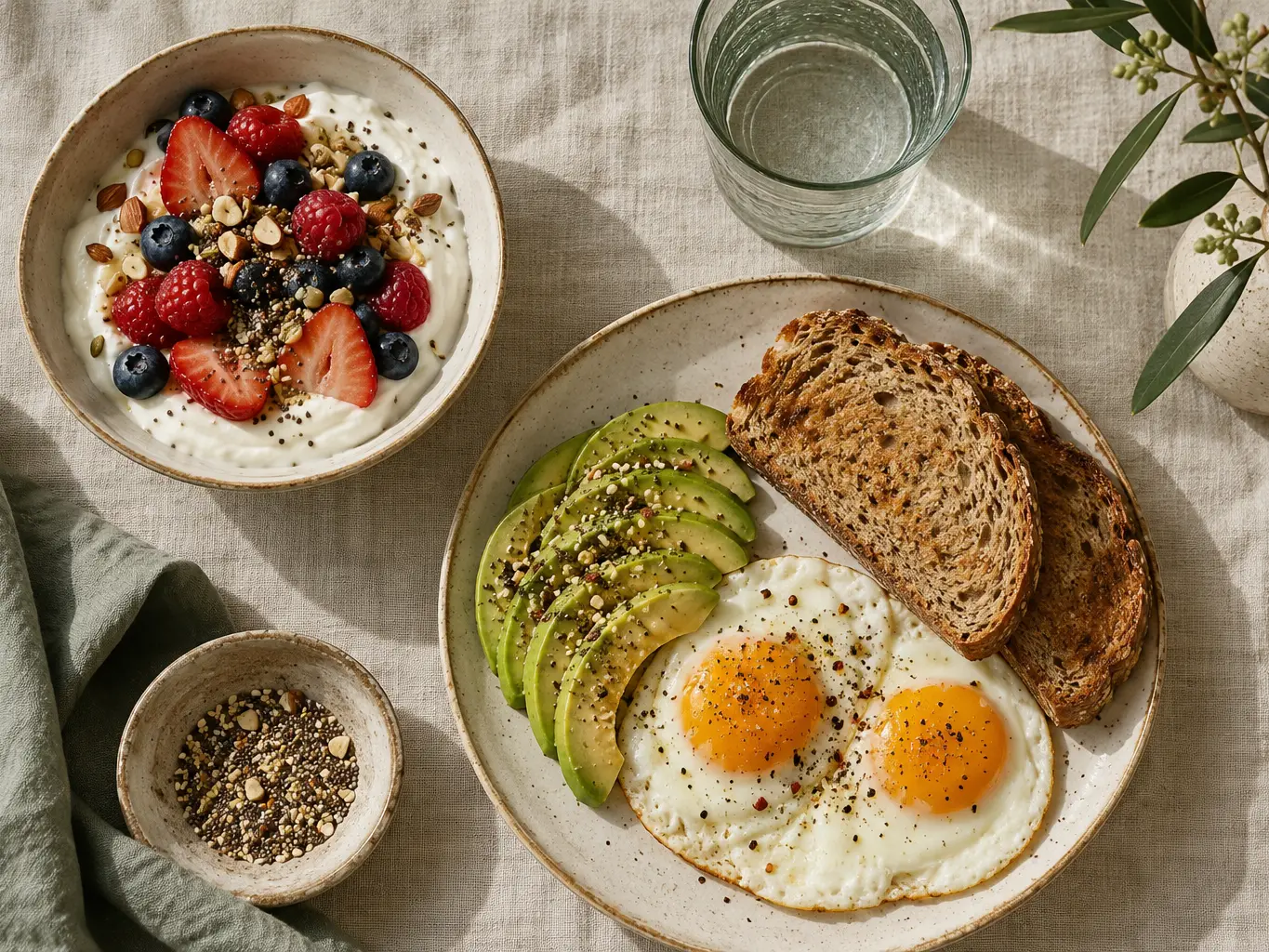
| Breakfast | Greek yogurt with berries and chia seeds | Protein first, fruit and seeds; eating early can ease morning nausea |
| Lunch | Lentil and vegetable soup with a slice of whole-grain bread | Plant protein and fiber; soups go down easily when appetite is low |
| Snack | Cottage cheese with sliced apple, or a small handful of almonds | Keeps meals small and regular |
| Dinner | Baked fish or beans, broccoli, a small serving of brown rice with olive oil | Lean protein, vegetables, whole grain, plant oil |
| Through the day | Water, ginger or peppermint tea | Fluids to prevent dehydration |
If solid food feels heavy, the advisory notes that smoothies made with fruit, vegetables and yogurt or unsweetened milk, cottage cheese and soups are often easier, and that setting a reminder to eat can help.
Vitamins, strength training and extra help
On a much smaller food intake, some nutrients can run low. The advisory says supplements for vitamin D, calcium and vitamin B12 can be considered, tailored to each person. Ask before adding any.
For muscle and bone, pair protein with structured strength training. The advisory also recommends screening for eating disorders before starting a GLP-1, and says a restrictive eating disorder is generally a reason not to use one. A registered dietitian can turn these principles into a plan that fits your tastes, culture and budget.
Safety: the boxed warning comes first
Zepbound, Wegovy, Ozempic and Mounjaro carry a boxed warning for thyroid C-cell tumors. Semaglutide caused these tumors in mice and rats, and tirzepatide in rats; it is unknown whether they do in humans. They are not for people with a personal or family history of medullary thyroid carcinoma (MTC) or Multiple Endocrine Neoplasia syndrome type 2 (MEN 2).
Two other label warnings tie to eating. Dehydration from vomiting or diarrhea can cause kidney injury, so keep drinking. Gallbladder problems, which the Zepbound label says were associated with weight reduction, can cause pain in the upper stomach, fever, yellow skin or eyes, or clay-colored stools; tell your clinician right away. Our GLP-1 side effects guide has the full list.
The bottom line
A GLP-1 diet is ordinary healthy eating, scaled down: protein first at each small meal, plenty of plants and whole grains, more than 2 liters of fluid, and less greasy food, sugar, fast food and alcohol, especially after a dose increase. Pair it with strength training and check in with a dietitian if you can. To see how quickly weight usually comes off on these medications, read how long GLP-1s take to work, and when you are ready to compare programs, see our list of GLP-1 providers.
Highest-scored weight loss programs
The three weight loss programs with our highest overall scores right now.
- Safety: GLP-1 medications carry a boxed warning for thyroid C-cell tumors. Read the safety information
- 02Measured
Low compounded prices, plus prior authorization help for brand-name GLP-1s
Rated 9.0 out of 10, Excellent
From $199/mo
Visit site for Measured (opens in a new tab) - 03MEDGm
Labs and video access included, with tablets and brand-name options
Rated 9.0 out of 10, Excellent
From $299/mo
Visit site for MEDGm (opens in a new tab)
Questions, answered
What is a GLP-1 diet plan?
What should I eat on Zepbound?
What foods should I avoid on Zepbound?
How much protein do I need on a GLP-1?
Can I take the Wegovy pill with food?
Sources
- Mozaffarian et al., Nutritional priorities to support GLP-1 therapy for obesity: a joint advisory (ACLM, ASN, OMA, TOS), Obes Pillars 2025
- Full text of the joint advisory, PMC (read Oct 27, 2026)
- Sievenpiper et al., Nutritional and lifestyle supportive care recommendations for GLP-1 based therapies: expert consensus, Obes Pillars 2025
- Eli Lilly: Zepbound prescribing information and Medication Guide (rev. 08/2026, read Oct 27, 2026)
- Novo Nordisk: Wegovy prescribing information (rev. 06/2026, read Oct 27, 2026)