In short
- KLOW combines 4 peptides (GHK-Cu, BPC-157, TB-500 and KPV). GLOW is the same mix without KPV. None of the 4 is FDA-approved.
- As of October 27, 2026, a licensed pharmacy may not compound either blend as an injection, because BPC-157, TB-500, KPV and injectable GHK-Cu all fail the 3 tests in section 503A.
- On July 23, 2026, an FDA advisory committee voted 8 to 6 for BPC-157, TB-500 and KPV, according to law-firm reports. FDA’s own reviewers had recommended against all 3.
- The FDA says it has not identified any human exposure data for TB-500 or KPV, by any route.
- Topical GHK-Cu, back in FDA Category 1 since May 14, 2026, is the only part of these blends a pharmacy may compound for you.
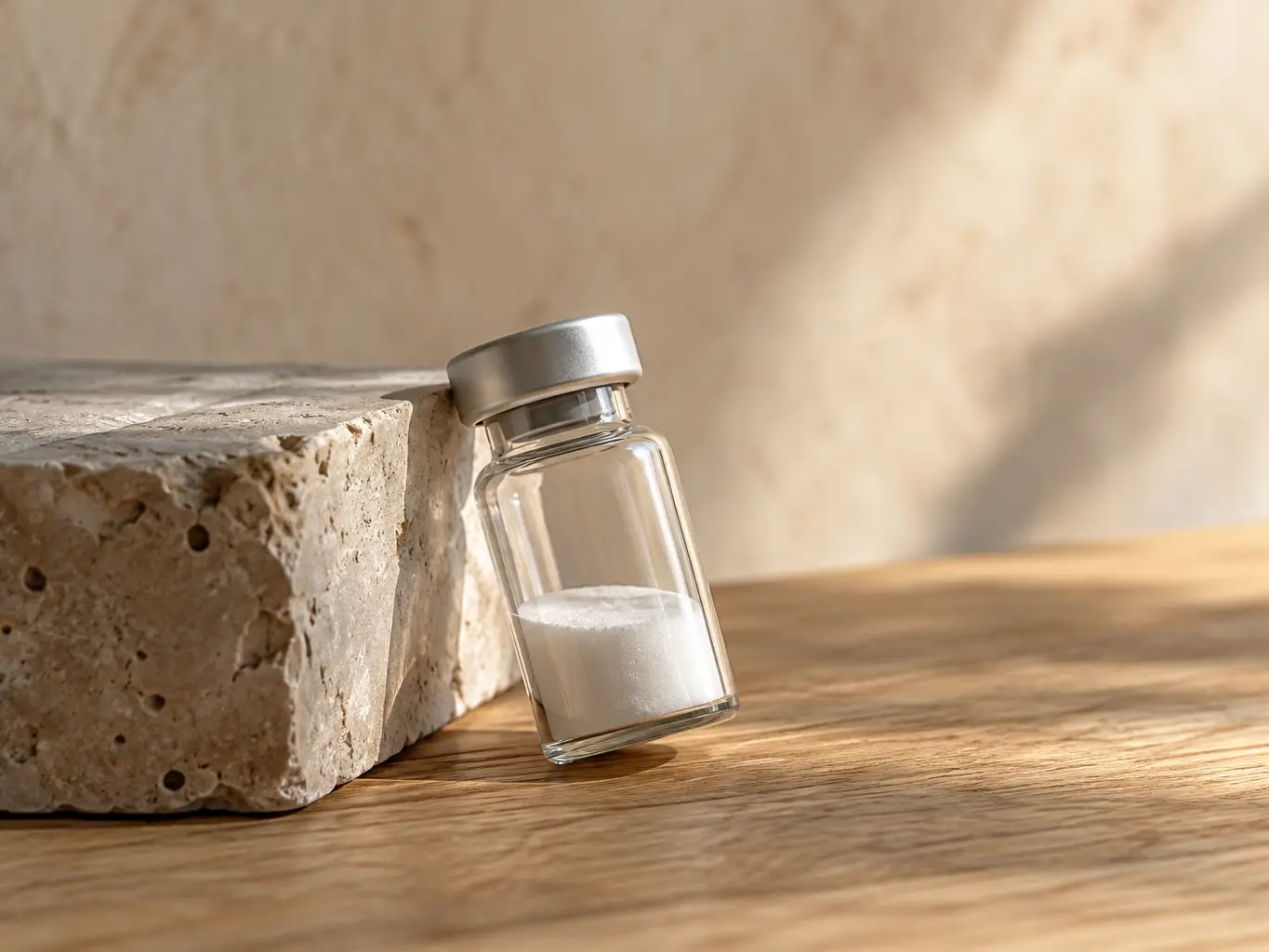
KLOW is a blend of four peptides, usually sold online as a powder in a vial for injection: GHK-Cu, BPC-157, TB-500 and KPV. GLOW is the same mix without KPV. Neither blend, and none of the four ingredients, is FDA-approved, and as of October 27, 2026 a licensed pharmacy may not compound either one as an injection. The only piece of these blends you can get lawfully is GHK-Cu prepared as a cream or foam for the skin. This guide sets out what each ingredient is, what the FDA decided about each one in 2026 and what is still undecided. It doesn’t point to any seller, because there is no lawful source for the blends.
What’s in GLOW and KLOW
Neither name is a drug name. GLOW and KLOW are labels that sellers put on mixed vials, and no standard says how much of each peptide a vial holds. Sellers agree on the ingredient lists:
| Blend | Ingredients |
|---|---|
| GLOW | GHK-Cu, BPC-157, TB-500 |
| KLOW | GHK-Cu, BPC-157, TB-500, KPV |
Here is what each ingredient is, using the FDA’s own descriptions where it has published them:
- GHK-Cu is a peptide of three amino acids (glycine, histidine and lysine) bound to copper. It occurs naturally in human plasma, and it has been used in skin and hair products for years (Pickart and Margolina, 2018).
- BPC-157 is a lab-made chain of 15 amino acids (FDA briefing document).
- TB-500 is a lab-made fragment of 7 amino acids (positions 17 to 23) taken from thymosin beta-4, a natural peptide, with an acetyl group added at one end (FDA briefing document).
- KPV is a fragment of 3 amino acids (lysine, proline and valine) from alpha-melanocyte-stimulating hormone, which the pituitary gland makes (FDA briefing document).
The names on the labels add a problem of their own. The FDA’s reviewers found that products sold as KPV and TB-500 don’t follow standard chemical naming, and that different salts, and sometimes different molecules, are sold under the same common name. They called that a safety risk, because a patient may get a different substance from the one a prescriber ordered. The KPV review also notes that KPV is promoted in multi-peptide “regenerative” combinations with BPC-157 and TB-500.
Where each ingredient stands in October 2026
Scroll sideways to see the full table
| Ingredient | FDA-approved? | Can a 503A pharmacy compound it? | Status on Oct 27, 2026 |
|---|---|---|---|
| GHK-Cu, for the skin or scalp | No | Yes, under the FDA’s interim policy | Category 1 since May 14, 2026 |
| GHK-Cu, injectable | No | No | No category; committee review due by end of Feb 2027 |
| BPC-157 | No | No | No category; committee voted 8 to 6 in favor; FDA hasn’t acted |
| TB-500 | No | No | No category; committee voted 8 to 6 in favor; FDA hasn’t acted |
| KPV | No | No | No category; committee voted 8 to 6 in favor; FDA hasn’t acted |
Why a blend is only as lawful as its weakest ingredient
Under section 503A, a state-licensed pharmacy may compound only with bulk ingredients that have a USP or National Formulary monograph, are components of an FDA-approved drug, or appear on the FDA’s 503A bulks list. Each ingredient must also come from an FDA-registered manufacturer with a valid certificate of analysis (FDA). While the list is still being built, the FDA says it doesn’t intend to act against pharmacies that use substances in its Category 1. Every bulk ingredient in a compounded product has to clear one of these bars.
BPC-157, TB-500 and KPV clear none of them. The FDA’s briefing documents confirm that none has a USP monograph and none is a component of an approved drug, and none is on the bulks list or in Category 1. GHK-Cu clears the bar only for routes other than injection. A GLOW or KLOW injection therefore fails three or four times over, and a pharmacy may not lawfully make one.
April and May 2026: shuffled lists, not approvals
In April 2026, after their nominators withdrew, the FDA moved BPC-157, TB-500, KPV and injectable GHK-Cu off Category 2, its list of substances that may pose significant safety risks, and onto a list of substances “nominated but withdrawn” (FDA). That left them in no category, which is not the same as a green light. The FDA has also said it does not intend to place substances nominated on or after January 7, 2025 into any of its categories, so a new nomination wouldn’t open the door either.
GHK-Cu took a detour. The FDA removed it from Category 1 on April 22, 2026, when its nominations were withdrawn. On May 5, one nominator clarified that it had meant to withdraw only the injectable route, and the categories list updated May 14, 2026 puts GHK-Cu “except for injectable routes of administration” back in Category 1 (FDA). The FDA says it intends to consult its Pharmacy Compounding Advisory Committee on GHK-Cu before the end of February 2027.
What the FDA hasn’t decided
The July 23, 2026 votes
The FDA’s Pharmacy Compounding Advisory Committee spent July 23, 2026 on four peptides, including three of the blend ingredients: BPC-157 for ulcerative colitis, KPV for wound healing and inflammatory conditions, and TB-500 for wound healing (FDA). According to a law-firm report of the meeting, the committee voted 8 to 6, with 1 abstention, in favor of each one (McDermott). The FDA hasn’t posted minutes or an official vote record.
The FDA’s own review teams had recommended the opposite. For each of the three, the briefing document concludes that a balancing of the criteria “weighs against” adding it to the bulks list, citing poor chemical characterization and too little safety and effectiveness information. The committee did not consider GLOW or KLOW as blends; it voted on single ingredients.
No rule yet
The FDA describes its advisory committees as making “non-binding recommendations”, which it generally follows but is not legally bound to. To put any of these peptides on the bulks list, the FDA would have to publish a proposed rule in the Federal Register, take comments and issue a final rule. As of October 27, 2026, it has published no proposed rule for any of them, and its categories list is still the version updated May 14, 2026.
Even a final rule wouldn’t make a blend FDA-approved. It would let a 503A pharmacy compound the listed ingredient for an individual prescription, with no FDA review of whether the product works or is safe.
What the evidence covers
The case made for these peptides online rests mostly on cell and animal studies, and the FDA’s notes on each ingredient are blunt about the gaps:
- TB-500: the FDA says it “has not identified any human exposure data” on drug products containing it. Its briefing document found no report in the medical literature of TB-500 being given to patients for any condition, and no pharmacy that compounds it.
- KPV: the FDA says it has not identified human exposure data “administered via any route of administration”. Its reviewers found no study in which a compounded product containing KPV was used in people.
- BPC-157: the FDA says it has “no, or only limited, safety-related information for the proposed routes of administration”.
- Injectable GHK-Cu: the FDA says injected products may pose a risk of immune reactions and that “there are limited data in humans” to judge safety.
The TB-500 review did find two complaint reports in an FDA database about “blended TB-500 and BPC-157”, but they included no safety assessments, and the reviewers found no published case of TB-500 or KPV being given to people. Our own search of PubMed on October 27, 2026 turned up review articles that discuss these peptides, but no study of the GLOW or KLOW mixtures themselves.
Vials sold for research
GLOW and KLOW are sold mostly as powders labeled for laboratory research. The FDA treats such products as unapproved new drugs when they are sold for people to use: in a June 2023 warning letter it said so about injectable and nasal BPC-157 and TB-500 sold this way (FDA). A label saying a vial is for research doesn’t change what it is.
Buying these vials for personal use is unsafe and unregulated. No prescriber decides whether the product suits you, no licensed pharmacy answers for its contents, and no one has checked that it holds what the label says, at the stated amounts, free of bacteria and toxins. Our guide on whether peptides are safe explains how to check a provider.
The lawful option: GHK-Cu for the skin
The one ingredient of these blends that a pharmacy may compound is GHK-Cu, and only as a product you put on the skin or scalp, such as a cream or foam. A licensed clinician has to prescribe it, and a 503A pharmacy compounds it from a registered source under the FDA’s Category 1 interim policy. It is not FDA-approved, and the FDA doesn’t review compounded products for safety or effectiveness. It is also not GLOW: it contains one peptide, not three or four, and it isn’t injected.
Our topical GHK-Cu treatment page covers what it is, the evidence and its side effects. For the other ingredients, see our guides to BPC-157, BPC-157 vs TB-500 and KPV, and the peptide legal status guide for every popular peptide.
The bottom line
KLOW is GHK-Cu, BPC-157, TB-500 and KPV in one vial; GLOW drops the KPV. None of the four is FDA-approved, three of them can’t be compounded at all, and GHK-Cu can be compounded only for the skin, so no pharmacy may lawfully make either blend as an injection. The July 2026 committee votes are recommendations the FDA hasn’t acted on, and the FDA’s own reviewers argued against them. If you are interested in peptide therapy, start with a licensed clinician and the peptides hub, and treat any offer of a GLOW or KLOW prescription as a warning sign. We’ll update this page when the FDA publishes a decision.
Questions, answered
What is the GLOW peptide?
What is in the KLOW peptide blend?
Is the GLOW peptide blend legal?
Is KLOW FDA-approved?
What is the difference between GLOW and KLOW?
Sources
- FDA: Certain bulk drug substances for use in compounding that may present significant safety risks (content current Apr 22, 2026; read Oct 27, 2026)
- FDA: Bulk drug substances nominated for use in compounding under section 503A (categories list, updated May 14, 2026; read Oct 27, 2026)
- FDA: Bulk drug substances used in compounding under section 503A of the FD&C Act (content current May 14, 2026)
- FDA: July 23-24, 2026 meeting of the Pharmacy Compounding Advisory Committee (agenda and materials)
- FDA briefing document: BPC-157-related bulk drug substances (July 2026 PCAC)
- FDA briefing document: TB-500-related bulk drug substances (July 2026 PCAC)
- FDA briefing document: KPV-related bulk drug substances (dated May 12, 2026; July 2026 PCAC)
- McDermott Will & Schulte: PCAC backs majority of peptides in two-day public meeting (Jul 27, 2026)
- FDA warning letter on BPC-157 and TB-500 sold for research (Jun 12, 2023)
- Pickart L, Margolina A. Regenerative and protective actions of the GHK-Cu peptide. Int J Mol Sci. 2018;19(7):1987